
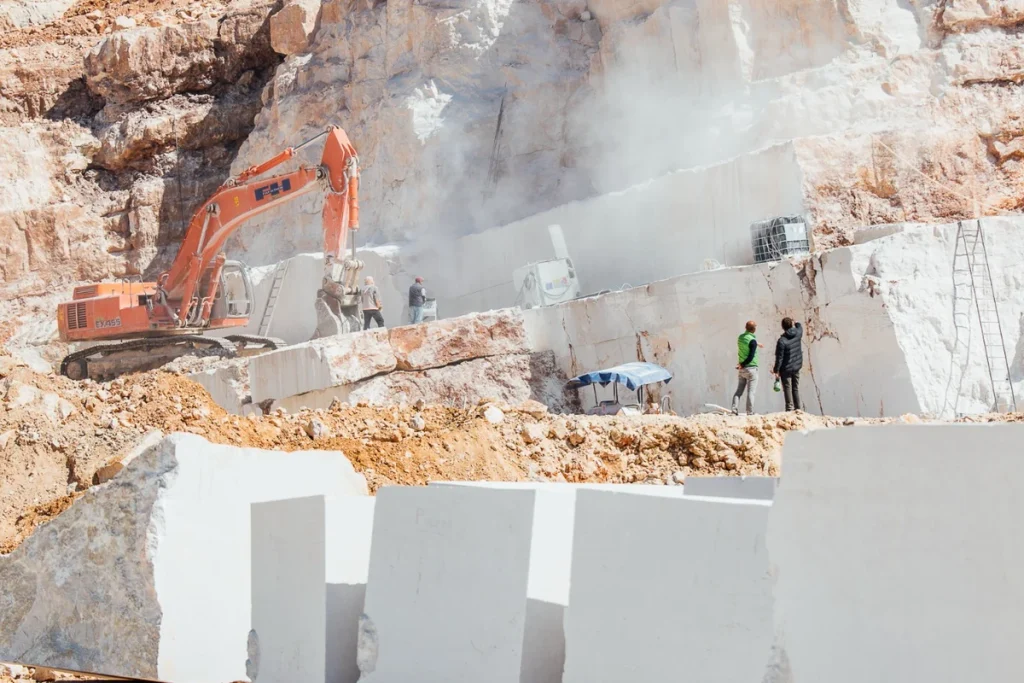
Marble extraction and processing tell a story that begins long before the stone finds its way into our homes. We are used to seeing marble at its finest: beautifully polished, featured in a designer kitchen, taking centre stage in a bathroom or transformed into an elegant piece of furniture.
But before getting there, that very same stone looked quite different.
It was part of a mountain, hidden between layers of rock, with a natural pattern that no one had yet seen in its entirety. Between these two moments lies a world that often remains unseen by those choosing the finished material. A world shaped by experience, technology, precision and, above all, a deep understanding of natural stone.
Today, we take you behind the scenes of marble extraction and processing to discover everything that happens before a slab finds its way into your home.
It all begins at the quarry. And nothing is left to chance.
Extracting marble is not simply about cutting into a mountain.
First and foremost, it means knowing how to read it.
The structure of the rock, the direction of the veining, the presence of natural fractures and the characteristics of the deposit are all factors that must be carefully assessed before extraction begins.
Using technologies such as diamond wire cutting, large sections of rock are separated and subsequently divided into blocks of suitable dimensions for transportation and further processing.
The aim is to make the most of the raw material, respecting its natural characteristics while maximising the amount of usable stone. Technology has certainly transformed quarrying over the years, but there is one thing no machine can replace: the experience of those who truly understand stone.
Same quarry, same marble. Almost.
One of the questions we are asked most frequently concerns the differences between slabs of the same material.
How can two slabs from the same quarry look so different? The answer is simple: nature does not mass-produce.
Even within the same deposit, blocks can display different shades, more or less pronounced veining, fossil traces and subtle variations in colour.
This is precisely why block selection is such an important stage.
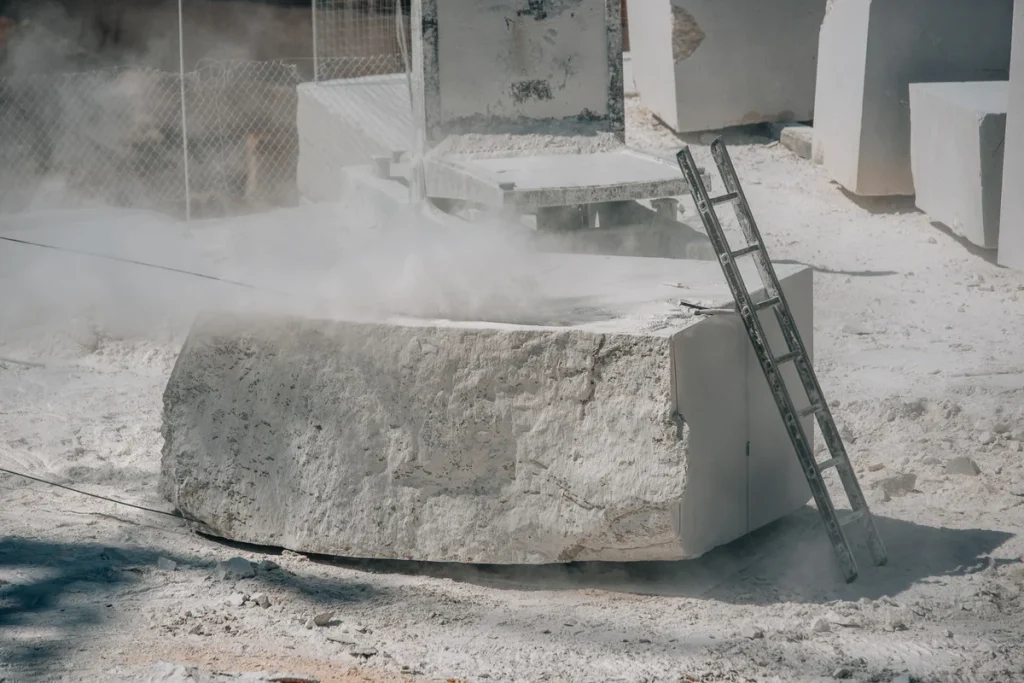
It is not just about assessing the appearance of the material, but also its structural integrity, dimensions, the direction of its veining and its processing possibilities.
Some blocks stand out for their uniformity, while others are prized for their distinctive aesthetic qualities. Certain selections are so rare that they may only be available in limited quantities.
This is also one of the reasons why two slabs of the same marble can vary significantly in price.
From block to slab: when stone reveals its natural pattern.
There is a particularly fascinating stage in marble processing: the cutting of blocks into slabs.
Once transported to processing facilities, the blocks are cut using specialised machinery, such as gang saws and multi-wire diamond cutting systems, to produce slabs of the desired thickness.
This is when we truly discover what the block has held hidden within.
Veining, shades and details that could previously only be guessed at from the outside finally become visible.
The cutting direction can also dramatically influence the final appearance. With certain materials, cutting the stone in one direction rather than another can result in surfaces with a completely different look.
Consecutive slabs from the same block can also be used to create bookmatched compositions, arranging the surfaces in a mirrored pattern and transforming the natural design of the stone into a distinctive architectural feature.
A striking visual effect created not by graphic design, but by nature itself.
One stone, many personalities.
Once cut, a marble slab does not necessarily have the appearance we are accustomed to seeing.
This is where surface finishes come into play, transforming not only the appearance of the material but also the way we perceive and experience it.
- Polishing enhances the colours and depth of the veining, creating a glossy, reflective surface.
- Honing gives the stone a softer, matte and understated appearance.
- Brushing enhances the natural texture of the stone, creating a more tactile surface that is pleasant to the touch.
- Bush hammering creates a rougher surface characterised by a distinctive, irregular texture.
The choice of finish depends on the desired aesthetic, as well as the intended application and the characteristics of the material itself.
This is why, when choosing marble, it is important to look beyond its colour and veining. The finish is not a detail. It is an integral part of the design.
Three quarries, three territories, three distinct identities.
At Miramarmi, our relationship with stone begins long before it arrives at our warehouse.
It begins directly at the quarry.
Our three privately owned quarries reflect three different regions, each with its own geological and aesthetic identity.
Daino – Orosei, Sardinia.
Since 1972, we have been quarrying this natural stone, also known as Orosei Marble or Breccia Sarda. Its warm tones, beige shades and distinctive veining make it an exceptionally versatile material, perfectly suited to both classical and contemporary architecture.
Botticino – Brescia, Italy.
A timeless classic of Italian natural stone. Characterised by luminous tones, delicate veining and fossil traces, it is a material that transcends generations without losing its contemporary appeal.
Travertine Bianco – Albania.
A natural stone with a distinctive character, recognisable for its light shades, layered structure and characteristic porosity. A particularly compelling material for projects where texture takes centre stage.
Owning our quarries means gaining first-hand knowledge of the materials we offer, understanding their unique characteristics, overseeing their selection and responding with greater expertise to the needs of stone fabricators, architects and designers.
Because truly understanding a stone also means knowing where it comes from.
And what happens when the slab reaches the showroom?
By this point, the marble has already been on quite a journey. And yet, the most creative part of its story is still to come.
In our warehouse, every slab still holds a world of possibilities.
It could become a kitchen worktop, the wall cladding of a hotel, a table around which family and friends gather every Sunday, or a small detail capable of completely transforming the feel of a space.
The project will ultimately give it its final form.
And perhaps this is the most fascinating aspect of natural stone: a material formed over millions of years that, through human craftsmanship and creativity, finds its place in everyday life.
The next time you choose a marble slab, look beyond its veining. There is much more to that surface than meets the eye.
Every stone has a story. Come and discover ours.
Discover our quarries, explore our selection of materials or visit the Miramarmi showroom in San Pietro Mussolino, Italy.