
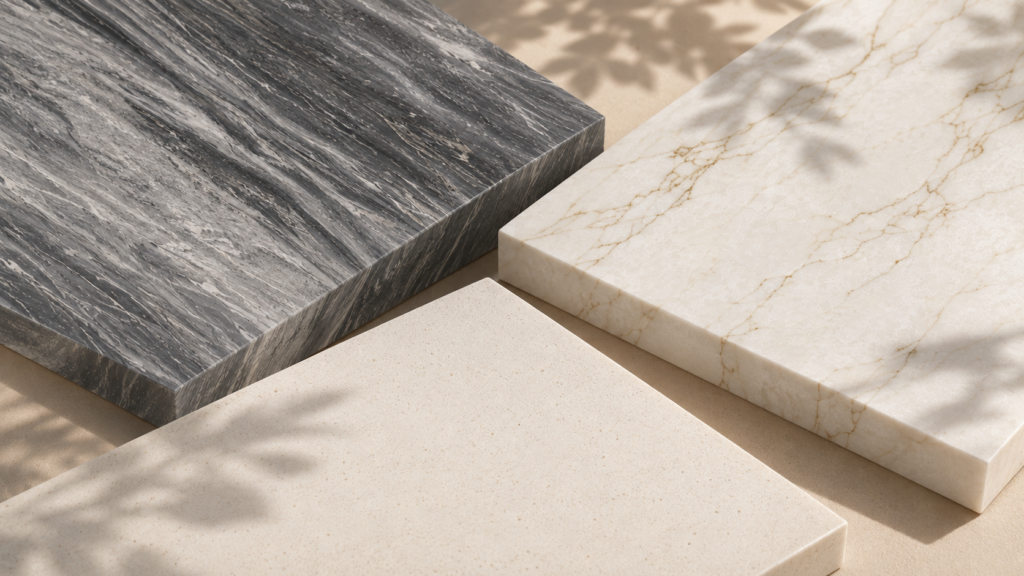
Natural marble, Agglomarble, and Polarite. Three categories, three completely different ways of interpreting a surface. Let’s clear things up.
Natural and engineered marble may look like beautiful stone slabs at first glance. But behind seemingly similar surfaces lie very different compositions and characteristics.
But if we look beyond the surface, the differences start to get interesting.
On one hand, there’s natural marble, which takes millions of years to form. On the other, there are engineered materials, created through manufacturing processes that produce surfaces with different compositions and properties.
And there’s one thing we should make clear right away: not everything that looks like marble is necessarily marble.
So, before choosing based on colour alone (we know how hard it can be to resist a beautiful marble vein), let’s explore what really sets apart the three material categories you’ll find at Miramarmi.
Natural Marble: The Original, No Introduction Needed.
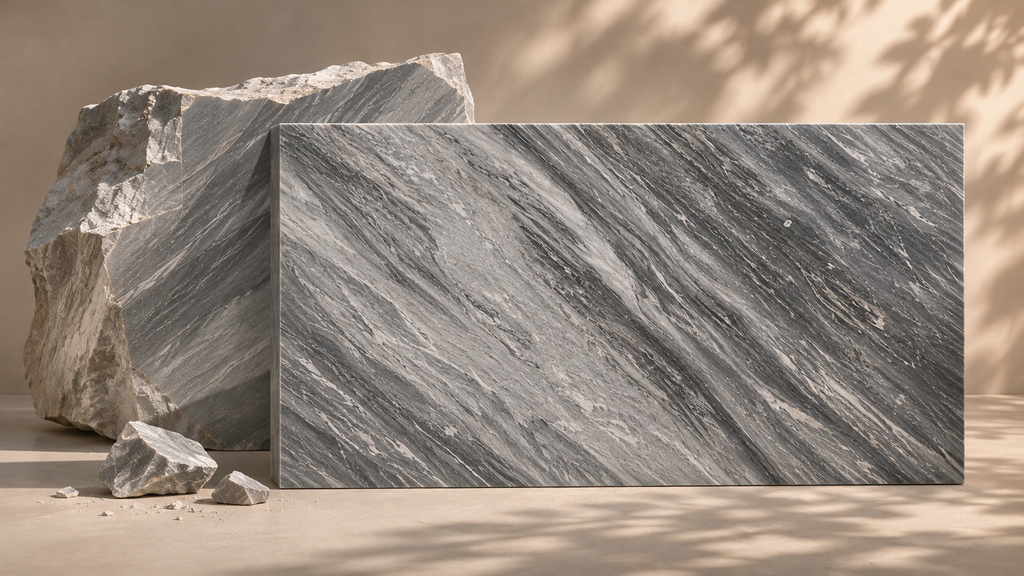
Natural marble has one unique characteristic that no technology can perfectly replicate: no two slabs are exactly alike.
It forms through geological processes that take millions of years, during which the rock transforms and develops its own unique characteristics. Once extracted from the quarry in the form of blocks, it is cut into slabs and processed according to its intended application.
But it’s above all its appearance that makes it instantly recognisable.
Veins running across the surface, shades that shift from one area to another, subtle inclusions and colour variations: every detail tells a story about how the stone was formed.
And no, these aren’t imperfections to be removed. They’re exactly what makes natural marble so fascinating.
This also means that choosing natural marble isn’t just about choosing a colour. Two slabs of the same marble variety can feature different patterns and shades while still maintaining the distinctive characteristics of that material. And the differences aren’t purely aesthetic: each marble variety has its own specific technical properties, which influence the choice of processing techniques, finishes, and applications.
When Should You Choose It?
When you’re looking for authentic natural stone with unique shades and veining. It’s an option worth considering for flooring, wall cladding, furniture, and architectural elements, choosing the marble variety best suited to your project.
After all, nature took millions of years to create it. The least we can do is take a few minutes to choose the right slab.
Agglomarmo: Marble, but with a Different Recipe.
What if we took natural marble, crushed it into small chips, and gave it a whole new form?
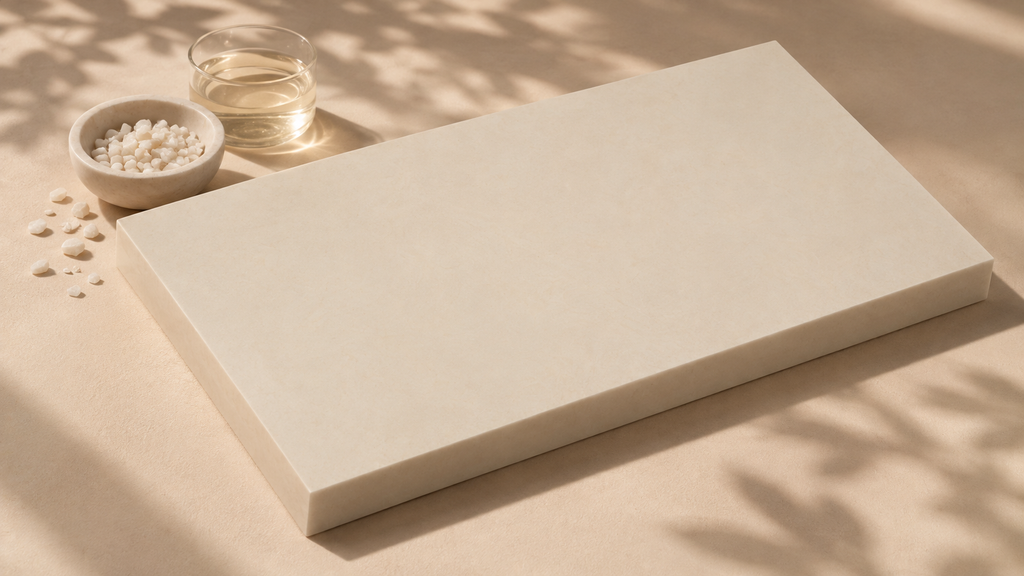
That’s exactly the principle behind Agglomarmo, an engineered marble material made by combining marble chips and resin.
Miramarmi’s Agglomarmo is made of approximately 95% natural marble chips and 5% polyester resin.
The mixture is processed to produce blocks and slabs, available in a variety of color, marble chip sizes, and thicknesses.
But what makes it different from natural marble?
First of all, the way its appearance is created.
In natural marble, veining is the result of geological processes. In Agglomarmo, however, the selection of marble chips, their sizes, and colours helps define the final appearance of the material.
The result is a surface with a generally more uniform and consistent appearance, where the marble chips can be more or less visible depending on the product.
Another important difference is visual consistency: while every natural marble slab features unique variations, Agglomarmo offers greater uniformity across surfaces of the same type.
When Should You Choose It?
When you’re looking for a material made from natural marble but prefer a more consistent appearance and greater colour uniformity. It can be used for flooring, wall cladding, and various furniture elements, depending on the product’s technical properties.
So yes, the marble is still there. This time, it just followed a recipe.
Polarite: It Looks Like Natural Stone, but It’s a Different Story.
So far, we’ve explored materials that, in one way or another, contain natural marble.
With Polarite, however, we’re working with a completely different set of ingredients.
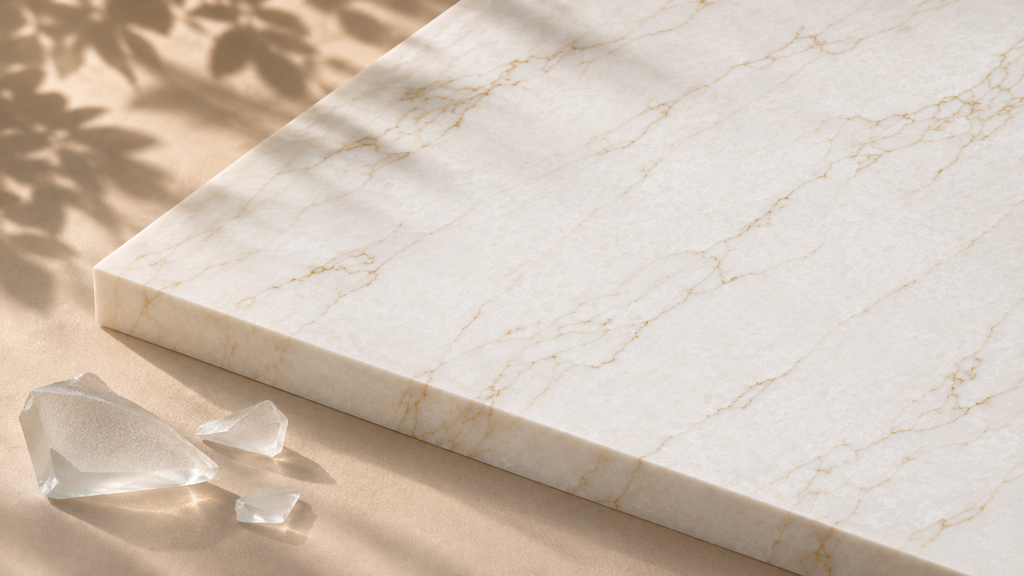
Polarite is an engineered surface made without marble chips, using recycled amorphous glass combined with DuPont® resin.
The glass component is made entirely from recycled glass, and the formulation is free from crystalline silica. A composition that’s significantly different from both natural marble and Agglomarmo.
The interesting part? Despite this difference, Polarite can recreate the appearance of natural stone, with a variety of veining patterns, shades, and colors.
Just look at materials like Montclair Gold, Calacatta Viola, or Taj Mahal to see how much the final appearance can vary.
But remember: looking like natural stone doesn’t mean having the same properties.
Polarite’s composition gives it specific properties and usage recommendations that should be considered according to the intended application.
It is an engineered surface suitable for various indoor applications, including kitchen countertops and wall cladding, but it is not suitable for outdoor use.
When Should You Choose It?
When you’re looking for an indoor surface with an alternative composition to traditional materials, formulated without crystalline silica and available in a variety of designs and finishes.
Because sometimes, what looks like marble actually tells a completely different story.
Natural Marble, Agglomarble, and Polarite: Key Differences at a Glance.
Three material categories that may share some visual similarities but have completely different compositions.
| Category | What It’s Made From | What Makes It Different | |
| Natural Marble | Natural stone extracted from a quarry | Unique veining and color variations | |
| Agglomarble | 95% marble chips 5% resin | More consistent and uniform appearance | |
| Polarite | Recycled amorphous glass < and resin | Crystalline silica-free composition |
The difference, therefore, goes beyond what we see.
It’s mainly about what’s inside.
And it’s precisely the composition that influences the technical properties, fabrication possibilities, maintenance requirements, and most suitable applications for each surface.
So, Which One Should You Choose?
It would be great to have a one-size-fits-all answer. But it wouldn’t be very helpful.
The choice depends on the type of project, the intended application, the technical properties required, and, of course, the aesthetic effect you want to achieve.
Natural marble offers the uniqueness of a natural stone, with no two slabs ever exactly alike. Agglomarmo provides surfaces with marble chips and more controlled colour variations. Polarite features a different composition, with specific properties designed for indoor applications.
There’s no single best material. There’s simply the one that best suits your project.
And here’s a piece of advice we often give: don’t rely on photos alone.
Seeing Them in Person Changes Everything.
Photos can help you get an idea. But seeing a slab in person, comparing different surfaces, and feeling the various finishes for yourself is a completely different experience.
At Miramarmi, you can explore natural marble, Agglomarble, and Polarite up close, compare their properties, and choose the material that best suits your project.
And if you’re still unsure which one to choose, no problem: that’s what we’re here for. Because understanding the differences is the first step. Finding the right material is the next.
Have a project in mind? We’ll help you find the right material.